
Issawi Speaks of Drinkwine
The police chief relays information from the new Panthers and Taha to his men.

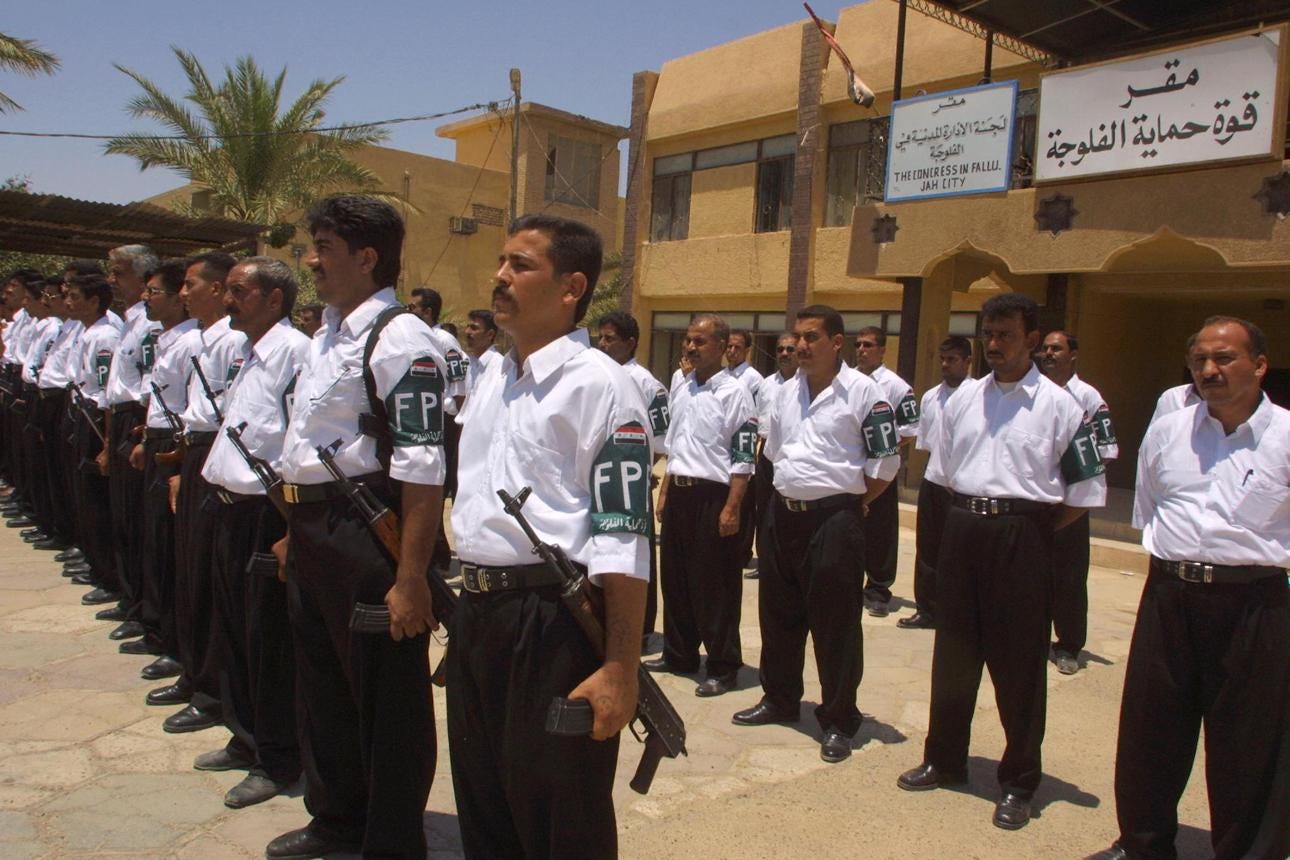
Soon after Drinkwine’s thesis made its rounds
A clamor swept across the town’s police
Who’d gathered late at night with nervous laughs
Imbued with giddy tones of cowboy grit.
They’d gathered at their downtown station house
Per secret all-hands memos from the chief
That said to meet inside the briefing room
And, what’s more, to bring AKs for each man.
Among these cops, of course, was Zulfiqar,
The soberest by temperament that night,
Who didn’t care to speculate about
What new directive they would undertake
And spent his waiting time just making sure
His peers’ AKs were oiled and maintained.

In contrast, young Mazir was riding high,
Not only on account of packing heat
But also from the vibrant laptop screen
That shined on his composite briefing desk
And blared with shaky handheld video
Acquired on some file-sharing site
Of some blonde Western woman, barely dressed
On stage before a massive, cheering crowd
Engaged in hip gyrations as she sang
And ran her hand across her shining abs.
“Christina Aguilera,” said Mazir
As he presented her to all around,
“I’m gonna get a wife like that someday
And never want for anything again.”

“A hooker?” teasing Khalid asked Mazir,
His voice low, almost looking for a scrap.
“Just go down to Baghdad. That’s half the girls.
You’d find a polar bear before a veil
In some of those disgusting neighborhoods.”

“We’re not all hicks like you,” Mazir shot back.
“I wouldn’t care if my wife didn’t veil.
Get with the times. We’re democratic now.
Fallujah, Paris, Amsterdam. You know?”

“Forget about if she’s a whore or not,”
Their electronics specialist, Iyad,
Chimed in, his arm around Mazir, his friend.
“That woman makes a million bucks a year
And you’re a short, provincial city cop
From somewhere she would never set a foot.
How are you gonna find a wife like that?”

For this, Mazir already had a plan
And gleefully expounded for the boys
While they all waited for their chief to come.
“I’ll bravely take a hit, or, just a graze,
Like Rambo, with my AK, from a fight
Where I mow through some filthy bandit slime.”
He punctuated this with pantomime
Of fi’ring his Kalashnikov full-spray
And made the mouth noise for the full effect
As Zulfiqar looked on with groans and smirks.
“And they’ll say, ‘Oh, Mazir! You saved our lives!’
The US troops, that is. When they see me.
And then they’ll take me to Baharia
Where they’ve got the massage room all transformed
To be a hospital for wounded men.
And, US doctors, they’re all hot blonde chicks,
I’ve seen it on TV, I swear it’s true,
And one’ll take my shirt and dress my wound
And look into my eyes, and she’ll be charmed,
And then she’ll marry me and come live here
And I’ll become a very wealthy man
By opening a chain of Pizza Huts
And have five children who will go to school
At Harvard, and have servants, and a pool.”

The specificities of this cop’s plan
Were cut short by Issawi’s tardy shout,
“Look sharp! You are police. Not high school boys,”
As he came to the lectern from the hall.
With clipboard in his hands, the harried chief
Addressed his full room of Iraqi blues
Who sat with some small shred of discipline
And wood-stocked, oiled AKs on their laps.
“I just spoke to the mayor. Here’s the deal.
The civil service has been getting threats
From idiots who want to start jihad
And kill every Fallujan they can find
Who goes along with the Americans.
We are the thin blue line here in Iraq.
We serve the mayor, and we serve the town,
And at this moment we must do two things.
The first is we must safeguard Taha’s life.
The man is pulling eighty hour weeks
Holed up there in his office down the street
Just keeping the utilities online.
The second is we must root out these thugs
And sweep away the mafioso filth
That seems to be mutating day by day
Into a darker, crazier new beast.
For these jobs I will split you into teams
And, in addition to your normal beats,
You’ll take shifts on these special, secret tasks.
As wolves, you’ll hunt in packs, and hunt at night.”

“But Chief,” Mazir then asked, a hand outstretched,
With Aguilera dancing on his screen,
“I thought you said we shouldn’t get involved
Because the US troops were doing raids
And we don’t want to get caught up in that
And risk creating problems. So what changed?”

Then, in response, the chief relayed more news
That came to all assembled as a shock.
“This morning, the Americans and I
Went down in big trucks to Baharia
And I met Drinkwine, who is their new boss,
And Drinkwine said to me, ‘Issawi, sir,
The past commanders who were stationed here
Did not make proper use of your police.
They treated you like children, cast aside
And only fit for stopping petty crime.
But I know you are warriors at heart
And I know you can take the city back,
And I want to empower you, wise Chief,
To let your men kick ass and take some names.’”

At this, there was a proper cowboy whoop
From all the men inside the briefing room,
And even Zulfiqar joined in the cheer,
Enamored with the trust and the prestige.
This is Canto 20, part of Book V, from Cantica One: Army, part of the Fallujiad. New cantos are published on Mondays and Thursdays.
The Fallujiad is an ongoing epic poem in blank verse about the Iraq War by Cairo Smith. Read the author’s introduction to the Fallujiad here.
Thank you as always Cairo!
I'm curious about a couple of things. First, your poetry seems quite literal, quite straightforwardly descriptive of events. When you said on the last post that you didn't want to be 'overly ostentatious', I was surprised to hear this from a poet, talking about one of only three or four metaphors in the entire Canto. To me it seems you have written this more like a novel than what I expect from a poem. How deliberate is this? Is it just your style, or do you think it's more in keeping with the kind of poem you're trying to write, to avoid elaborate metaphor and imagery and 'stick to the facts'?
Second: your storytelling is incredibly grounded and obviously based on very thorough research. I would be curious to know where the line is between invented details and historical fact. For instance, I've just looked up Janabi to discover that he's real. Who in this story is real and who is invented? The dialogue exchanges between real people - on the whole are they educated guesses or pure speculation?